In the modern world, data centers are the lifeblood of organizations, enabling everything from cloud computing to seamless e-commerce operations. Behind the curtain, two critical components—data center servers and data center ethernet switches—work in tandem to deliver the performance and responsiveness businesses rely on. But what exactly is the difference between these two key data center elements?
If you’ve ever wondered whether servers or switches are more critical to your network—or how they work together—this blog has the answers. By diving into their differences as well as their complementary roles, we’ll help you better understand the technologies driving today’s interconnected world.
What is a Data Center Server?
A data center server is the workhorse of the modern network. Servers are sophisticated computing devices responsible for processing, storing, and managing data. They host applications, power virtual machines, and provide the backbone for high-performance workloads.
Key Functions of a Data Center Server:
Data Processing and Storage: Data center servers process user requests and store critical information such as databases, files, and applications.
Hosting Applications and Websites: Whether it’s a small business website or a large web application, servers handle hosting and users’ interactions.
Virtualization: Modern servers often run virtual machines, maximizing hardware resource utilization by allowing multiple "virtual computers" on a single physical machine.
Example: A business’s e-commerce platform hosted on a server processes customer orders, manages inventory databases, and analyzes web traffic.
Without servers, no data center could function effectively—they are the brains behind networked systems. However, these brains need a robust “nervous system” to connect to other devices, and that’s where data center ethernet switches come in.
What is a Data Center Ethernet Switch?
A data center ethernet switch is the traffic controller of a data center’s network. It manages the movement of data packets between servers, storage devices, and external endpoints like end-user devices. By establishing effective and efficient communication within the network, ethernet switches ensure that applications run seamlessly and without delay.
Key Functions of a Data Center Ethernet Switch:
Data Packet Routing: Switches determine the best paths for packets to travel and forward them to their destinations.
Managing Network Traffic: They ensure that data flows smoothly, prioritizing critical tasks and minimizing bottlenecks.
Enabling Scalability: Ethernet switches support expanding infrastructure by connecting new servers, storage units, and other devices.
Example: In a video streaming service like Netflix, ethernet switches manage the constant flow of data between servers and users to ensure smooth video playback.
These switches often deliver high-speed connections, supporting bandwidths from 10G to 400G and beyond, making them indispensable for modern data centers.
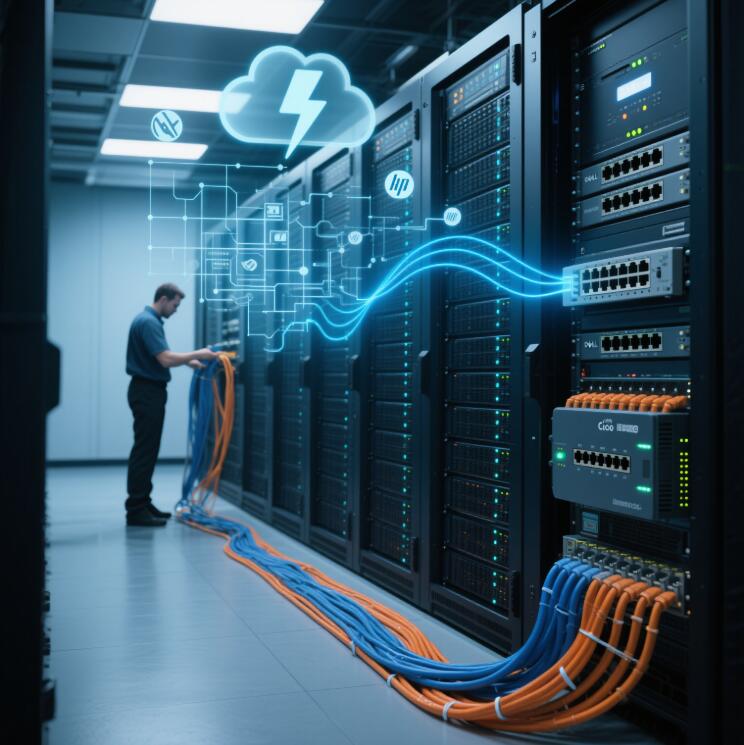
Key Differences Between Data Center Servers and Data Center Switches
Although they often work side by side, data center servers and data center ethernet switches fulfill very different roles. Here’s a breakdown of the key differences:
| Feature | Data Center Server | Data Center Ethernet Switch |
|---|
| Primary Function | Stores, processes, and manages data and applications. | Routes and forwards data across the network. |
| Role in Network | Computes and executes tasks as requested by users. | Manages data traffic between servers and devices. |
| Hardware Components | Processors (CPU/GPUs), memory, storage drives, etc. | Ports, ASICs (application-specific integrated circuits), etc. |
| Example Use Case | Hosting a website, running a database or virtual machine. | Ensuring seamless communication for applications like cloud services or high-frequency trading. |
| Position in Hierarchy | Endpoint devices in a network hierarchy. | Intermediate to core layer, connecting multiple endpoints. |
How Data Center Servers and Switches Work Together
To better understand their relationship, think of this analogy:
A data center server is like the brain of the data center—it performs computations, processes critical information, and runs applications. A data center ethernet switch, on the other hand, is like the nervous system—it transmits signals (data packets) quickly and efficiently across the network to enable the brain to focus on computations.
In practice, servers rely on switches to send and receive data, while switches depend on servers to perform processing tasks. Together, they form the foundation of modern IT infrastructure.
Why is a Data Center Ethernet Switch So Important?
A data center ethernet switch enhances your network’s performance and scalability by quickly directing data traffic. Here’s why investing in high-quality switches is so important:
Optimized Bandwidth Usage: Distributes data evenly across network devices to prevent congestion and delays.
High-Speed Communication: Enables quick data transfers with support for advanced speeds, such as 10G, 40G, 100G, or 400G connections.
Scalability for Growth: Connects hundreds or thousands of servers without sacrificing performance.
Low Latency for Critical Applications: Reduces delay for time-sensitive operations, such as AI-powered analytics or high-frequency trading.
Network Automation: Supports modern, software-defined networking (SDN) capabilities for centralized management and monitoring.
As network environments get more complex, choosing the right ethernet switch is critical. Lanbras's data center switches deliver top-tier performance, energy efficiency, and reliability.
How to Choose the Right Data Center Ethernet Switch
Selecting the ideal ethernet switch for your data center depends on your requirements. Here’s what to consider:
Performance Needs: Evaluate the bandwidth, speed, and latency requirements of your network.
Port Density: Consider the number of connections your network requires and ensure the switch supports future expansion.
Energy Efficiency: Opt for switches engineered to minimize power consumption.
Software Compatibility: Look for support for advanced capabilities, such as SDN integration for automated network management.
Manufacturer Quality: Partner with trusted and experienced manufacturers like Lanbras.
Ready to elevate your network's performance? Discover more about Lanbras's data center ethernet switch solutions.
Future Trends: Where Are Servers and Switches Headed?
Both data center servers and ethernet switches are undergoing rapid transformations to meet evolving demands. Here's what to expect in the near future:
Ethernet Switch Innovation:
Faster speeds, such as 800G, on the horizon.
AI-driven traffic optimization for real-time performance improvements.
Greater adoption of software-defined networking (SDN) for centralized, automated control.
Server Advancements:
Edge computing will complement centralized data centers, requiring smaller, lightweight servers.
Increased reliance on GPUs and other accelerators to support artificial intelligence and machine learning.
With a commitment to innovation, Lanbras is staying ahead of these trends, ensuring our customers have access to state-of-the-art solutions.
Conclusion
Both data center servers and data center ethernet switches are crucial components of modern IT infrastructure. Servers handle computational and storage tasks, while switches ensure smooth communication and high-speed data transfer within the network. Together, they create the backbone for everything from cloud storage to real-time analytics.
 EN
EN
 fr
fr  es
es  ru
ru  pt
pt  ar
ar  de
de 
 Internet Data Center
 FAQs
FAQs Industry News
 About Us
 Data Center Switch
  Enterprise Switch
  Industrial Switch
  Access Switch
  Integrated Network
  Optical Module & Cable


 Call us on:
  Email Us:
  2106B, #3D, Cloud Park Phase 1, Bantian, Longgang, Shenzhen, 518129, P.R.C.